
At this point, you'll be rather nervous that you've done something wrong,
so to make sure that you won't fry anything at least, get out your multimeter
and using an ohm range, verify that +5V on the CPU board is connected to
+5V on the Polysix boards, with the same for GND. Do the same for the
+15V,-15V,-5V and GND wires on the S/H board. Once you've assured yourself
that the the power wiring is properly connected, you can turn the Polysix
on.
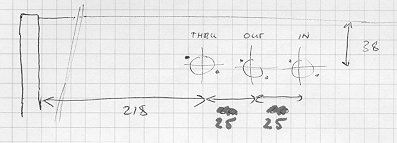
The exact measurements are given in the figure below (measurements
in mm).
When it comes to labelling the connectors, I used Letraset for the actual
label work, then masked off the surrounding area and covered the labels
with spray-on lacquer. It's not visible in the photo above, but the laqcuered
area does look different from the rest of the synth and you might opt
to do it differently for better looks. Martin Wise has produced
artwork
for labels for the connectors, together with labels for the PCB's and also
for the new functions available, to stick on the front panel.
If you're wondering what the mods actually do, here's a short description:
Back to the Polysix M page.
MIDI connectors
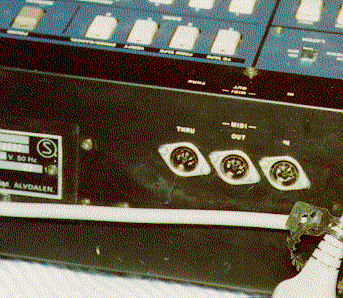
The MIDI connectors should be mounted in the location shown in the
picture below.
Although there appears to be a lot of free space on the rear panel, in
practice one has to make sure that the connectors don't get in the way
of anything on the inside. The indicated location has been selected with
this in mind. I mounted the DIN connectors at an angle to make my
bad drilling skills less obvious (I would never be able to line all the
screws up in a straight line), but that's all up to you.
Other modifications
Here you will find text descriptions of the
various modifications that must be made to the Polysix boards, including
the wheel assembly. Not much remains to be said regarding the modifications,
except to take your time and make sure you know what you're doing.
This page is (c) Copyright 1999 by Ricard Wolf